PRISM: Human Point Cloud Reconstruction
via Skeleton-Guided Diffusion
from mmWave Radar
Introducing MIST — the first mmWave dataset with a physical barrier between sensor
and subject — and PRISM, a skeleton-guided latent diffusion framework that reconstructs
LiDAR-quality human point clouds from sparse radar returns under three controlled occlusion levels.
PRISM reconstructs dense human point clouds from sparse mmWave radar across 30 MIST action classes
and three occlusion levels.
Abstract
From sparse radar signals to complete human shapes
mmWave FMCW radar offers all-weather, non-contact, privacy-preserving human sensing,
yet its inherent sparsity severely limits downstream body analysis and no existing dataset
provides a paired quantitative benchmark for dense human point cloud reconstruction under occlusion.
We present MIST, the first mmWave human point cloud dataset with a physical
barrier between sensor and subject. MIST pairs clear-view and through-obstacle captures of
the same subjects performing the same actions, with synchronized LiDAR as 3D ground truth
and a three-level occlusion design converting attenuation severity into a controlled variable —
spanning 8 subjects, 30 action classes, and 640k paired frames.
We also propose PRISM, a skeleton-guided conditional latent diffusion
framework reconstructing dense human point clouds from sparse mmWave radar alone.
SkelKD regresses radar-aligned joint positions via learnable cross-attention.
GeoAE produces density-invariant coarse body geometry.
Together with action class embeddings, these three conditioning streams guide a
Dynamic Transformer denoiser under a VP-SDE framework.
On MIST, PRISM achieves COV-CD 0.362 against 0.113 for the strongest
completion baseline; under through-obstacle attenuation where all baselines collapse to
fixed-template outputs, PRISM maintains meaningful reconstruction.
Method
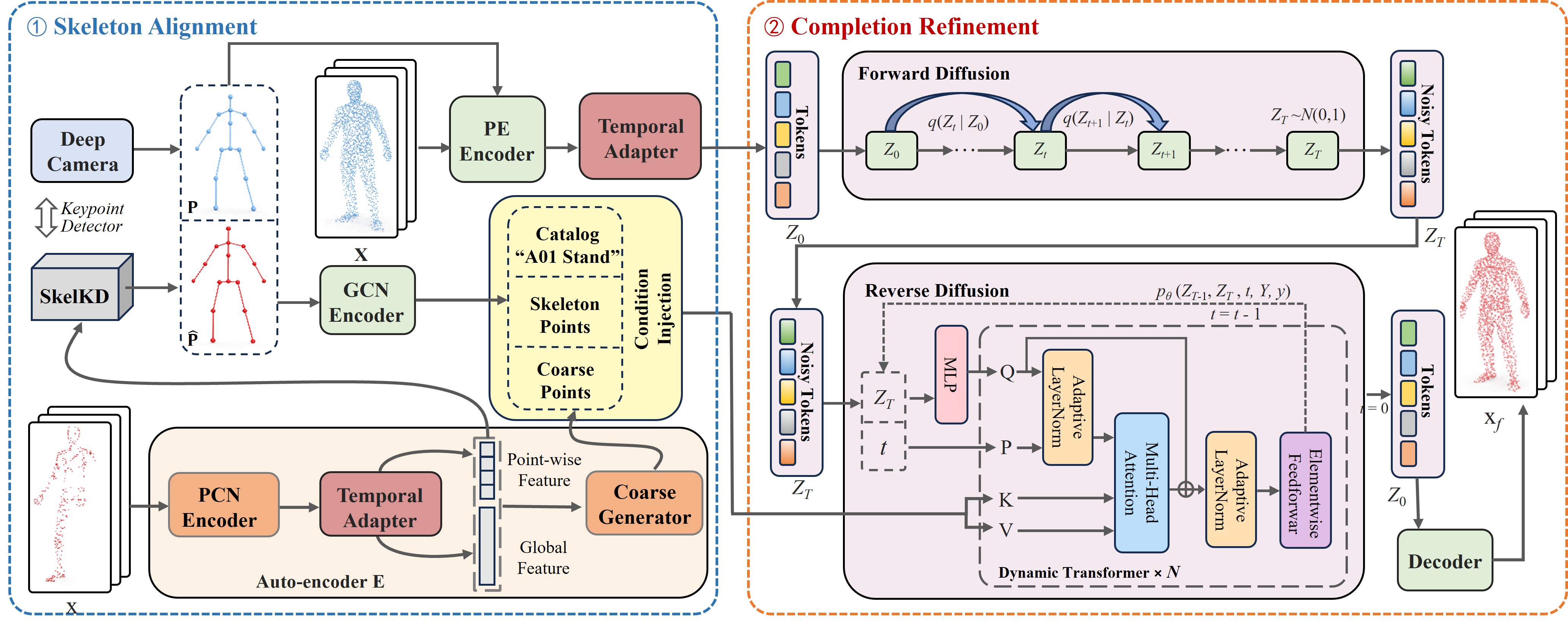
Two-path skeleton-guided architecture
The condition path processes the sparse mmWave cloud through SkelKD,
GeoAE, and an action class embedding, assembling three streams into a 145-token K/V
sequence injected at every denoising layer. The diffusion path encodes
the cloud into a compact 8×120 structured latent via HierVAE, iteratively denoises it
under a VP-SDE schedule driven by the condition K/V sequence through the Dynamic
Transformer, and decodes the result to a dense 256-point output cloud.
Figure 1. Overview of PRISM's two-path architecture for dense human point cloud reconstruction from sparse mmWave radar.
01
SkelKD
Takes sparse mmWave cloud as sole input and regresses 17 radar-aligned skeleton joints via 17 learnable query embeddings attending over per-point features. Trained with MPJPE loss and noise/masking augmentation to simulate occlusion; frozen before diffusion training.
02
HierVAE
Hierarchical VAE that encodes sparse point clouds into a compact 8×120 structured latent Z₀ through six levels of local grouping and residual self-attention. Decoder produces K=256 output points. Pre-trained and frozen so the denoiser trains within a stable latent geometry.
03
GeoAE + Condition Network
GeoAE learns a density-invariant mapping from sparse radar cloud to 128 canonical coarse body points, stable under occlusion. The Condition Network encodes GeoAE output and SkelKD GCN features into a 145-token K/V sequence; action identity enters the global AdaLN signal c = e_t + e_y + Linear(g_s).
04
Dynamic Transformer
Six ResidualBlocks alternating cross-attention (blocks 1, 3, 5) with self-attention (blocks 2, 4, 6), conditioned on the 145-token K/V sequence. AdaLN driven jointly by timestep, action label, and skeleton global pool. 200-step CFG inference yields X_f ∈ ℝ^(256×3).
Results
Quantitative & qualitative evaluation
Evaluated on MIST-OL0 (test subjects P07–P08, all 30 action classes) using distribution metrics:
COV-CD ↑ (fraction of ground-truth shapes covered) and MMD-CD ↓ (fidelity; ×10⁻³).
All baselines re-trained on MIST subjects P01–P06.
Method
Venue
Type
COV-CD ↑
MMD-CD ↓ (×10⁻³)
PCN
3DV'18
Completion
0.083
9.01
PoinTr
ICCV'21
Completion
0.113
8.26
SnowflakeNet
ICCV'21
Completion
0.079
10.72
LAKe-Net
CVPR'22
Completion
0.085
8.69
mmPoint
BMVC'23
Radar
0.097
8.91
LION
NeurIPS'22
Generative
0.185
7.37
TIGER
CVPR'24
Generative
0.209
7.08
PRISM (Ours)
—
Generative
0.362
4.91
PRISM achieves 3.2× coverage improvement over PoinTr and 40.6% lower matching distance.
Dataset
Multi-modal human sensing datasets
MIST Coming Soon
First mmWave human point cloud dataset with a physical barrier between sensor and subject.
Paired clear-view (OL0) and through-obstacle (OL1, OL2) captures with synchronized overhead
LiDAR as dense 3D ground truth. Dual TI IWR6843 radars, Livox Mid-360, and Intel RealSense D435i.
8 subjects · 30 action classes · 3 occlusion levels · ~640k paired frames.
To be released upon paper acceptance.
If you find PRISM useful in your research, please consider citing:
@inproceedings{prism2026,
  title     = {PRISM: Human Point Cloud Reconstruction via
               Skeleton-Guided Diffusion from MmWave Radar},
  author    = {Anonymous},
  booktitle = {Advances in Neural Information Processing Systems},
  year      = {2026}
}